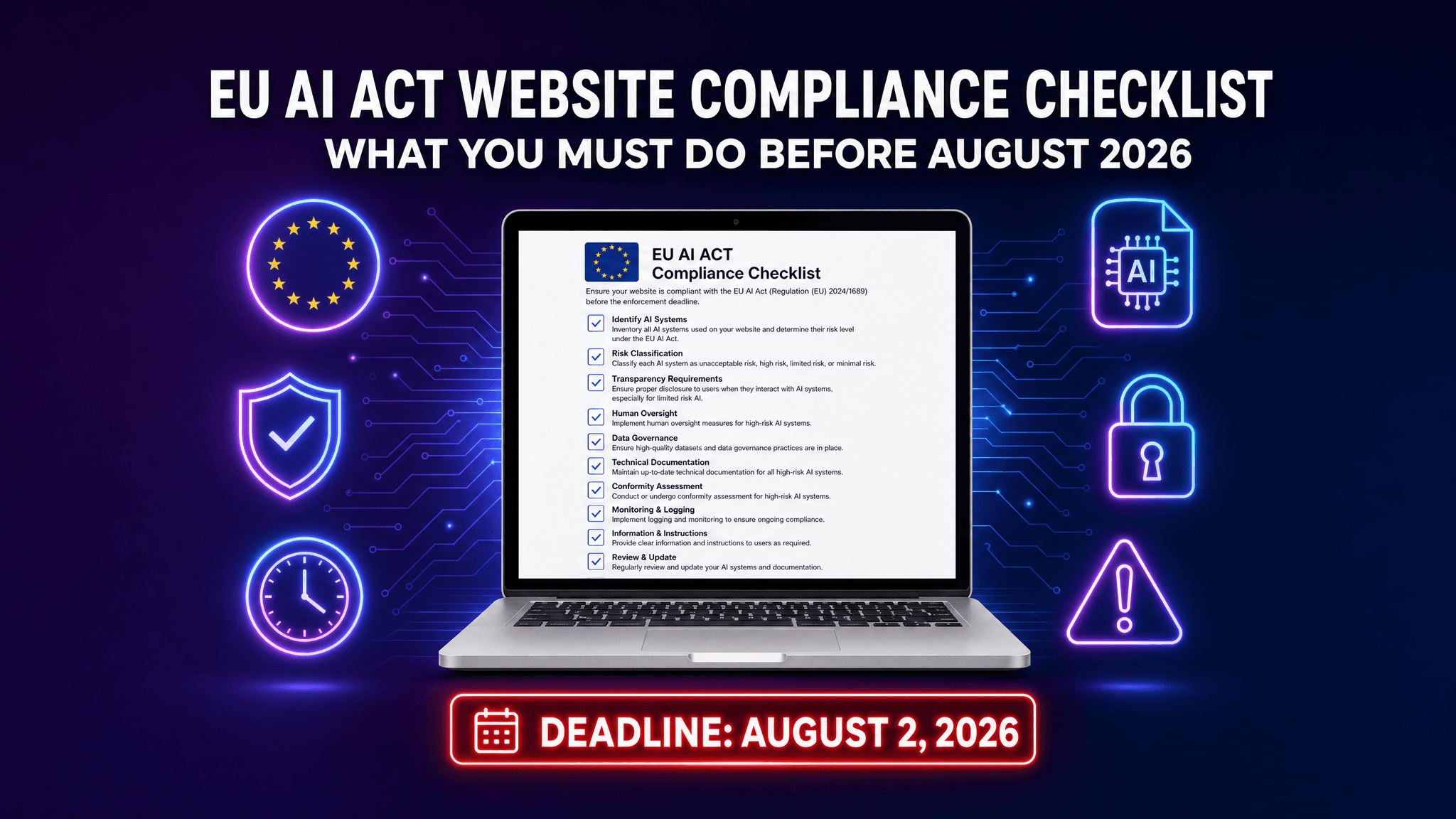
EU AI Act Website Compliance Checklist: What You Must Do Before August 2026
The EU AI Act's transparency obligations take effect on August 2, 2026. Learn exactly what your website needs to disclose about AI chatbots, deepfakes, and automated decision-making to avoid massive fines.
The regulatory landscape for Artificial Intelligence is shifting rapidly. While many businesses view the EU AI Act as a distant concern for massive tech conglomerates, the reality is far more immediate. By August 2, 2026, the grace period ends, and the transparency obligations outlined in Article 50 of the EU AI Act become fully enforceable.
If your website uses an AI customer service chatbot, generates synthetic content, or utilizes automated decision-making (ADMT), you are legally required to disclose this to your users. Failure to comply can result in devastating penalties of up to €35 million or 7% of global annual turnover.
This comprehensive checklist breaks down exactly what the EU AI Act means for your website and how you can update your privacy policy to ensure full compliance before the deadline.
1. Does the EU AI Act Apply to Your Website?
A common misconception is that the EU AI Act only applies to companies based in Europe. Similar to the GDPR, the AI Act has extraterritorial reach. It applies to any business—regardless of location—that deploys an AI system affecting users within the European Union.
You must comply with the transparency obligations if your website or app features:
- AI Chatbots: Any conversational interface powered by AI (e.g., customer support bots, virtual assistants).
- Synthetic Content: AI-generated text, images, audio, or video (often referred to as "deepfakes").
- Emotion Recognition: Systems that attempt to identify user emotions or biometric categorization.
- Automated Decision-Making: Algorithms that make significant decisions about users, such as loan approvals, hiring screening, or dynamic pricing.
If your SaaS product, e-commerce store, or mobile app utilizes any of these features, you are considered a "deployer" under the Act and must adhere to specific transparency rules.
2. The Core Transparency Obligations (Article 50)
Article 50 of the EU AI Act specifically addresses transparency. The fundamental principle is that users have the right to know when they are interacting with an AI system rather than a human.
Here is what you must disclose:
- Interaction Disclosure: Users must be explicitly informed that they are interacting with an AI system. This is particularly crucial for chatbots. The disclosure must be clear, prominent, and provided before or at the very beginning of the interaction.
- Content Labeling: If you publish AI-generated or manipulated content (deepfakes) that resembles real persons, objects, or places, it must be clearly labeled as artificially generated or manipulated.
- Data Usage: You must explain what data the AI system processes, how it is used, and whether it is used to further train the model.
- Human Oversight: If the AI system is used for automated decision-making, you must disclose the extent of human oversight and provide users with a mechanism to request human intervention or contest a decision.
3. Your EU AI Act Website Compliance Checklist
To ensure your website is ready for the August 2026 deadline, follow this actionable checklist:
Step 1: Audit Your AI Usage
Conduct a thorough inventory of all AI tools integrated into your website or app. This includes third-party SaaS tools, customer support widgets (like Intercom's Fin), and recommendation engines.
Step 2: Implement UI Disclosures
Update your user interface to include clear labels. For example, add a persistent badge to your chatbot window stating, "You are chatting with an AI assistant." Ensure any AI-generated blog images or synthetic media are clearly watermarked or captioned.
Step 3: Update Your Privacy Policy
This is the most critical step. Your privacy policy must be updated to include a dedicated section on Artificial Intelligence. It should cover:
- The specific AI systems in use.
- The purpose of the AI processing.
- The categories of personal data processed by the AI.
- Information on automated decision-making and profiling.
- User rights regarding AI interactions (e.g., the right to opt-out or request human review).
Step 4: Review Third-Party Agreements
If you use third-party AI APIs (like OpenAI or Anthropic), review their Data Processing Agreements (DPAs). Ensure you understand whether they use your users' data to train their models, and disclose this accordingly in your policy.
4. How to Generate an EU AI Act Compliant Policy
Drafting complex legal clauses for AI transparency can be daunting and expensive if you hire a lawyer. While platforms like Termly or iubenda offer general compliance tools, they often lack specific, easy-to-use generators tailored for the nuances of the EU AI Act.
That's where PrivacyPolicyGen.io comes in. We have updated our AI-powered generator to fully support the upcoming EU AI Act requirements as a dedicated document type.
Here are the simple steps to generate your policy:
- Go to the Generator: Visit our free generator page.
- Enter App Details: Fill in your website or app name and contact information.
- Select Data & Jurisdiction: Choose the data you collect and select "European Union (GDPR)" if you also need GDPR coverage.
- Choose Page Type: On the final step, select the "EU AI Act Policy" card.
- Generate: Click generate, and our AI will instantly draft the exact legal clauses required to keep your business compliant and avoid massive fines.
5. Frequently Asked Questions (FAQ)
When does the EU AI Act come into force?
The EU AI Act officially entered into force on August 1, 2024. However, it is being implemented in phases. The transparency obligations (Article 50) that affect most websites and chatbots become fully enforceable on August 2, 2026.
Does the EU AI Act apply to the UK?
No, the EU AI Act only applies to the European Union. Following Brexit, the UK is developing its own separate regulatory framework for AI. However, if a UK-based company offers services to users within the EU, they must still comply with the EU AI Act.
What is the penalty for non-compliance?
Fines for violating the EU AI Act can be severe. Depending on the severity of the infringement and the size of the company, penalties can reach up to €35 million or 7% of global annual turnover, whichever is higher.
How do I comply with the EU AI Act for my chatbot?
To comply, you must clearly disclose to users that they are interacting with an AI system before the conversation begins. Additionally, you must update your privacy policy to explain what data the chatbot collects, how it is processed, and whether it is used for model training.
6. Conclusion
The August 2026 deadline for the EU AI Act is approaching faster than it seems. Don't wait until the last minute to update your legal documents. By auditing your AI usage, implementing clear UI disclosures, and updating your privacy policy, you can build trust with your users and protect your business from significant legal risks.
Ready to secure your website? Generate your EU AI Act compliant Privacy Policy today.
Ready to generate your legal pages?
Start free with $1 in AI credits. No credit card required.
Generate Free →